
Sustainability in lieu of a throwaway society
The new CircEL project is researching ways to achieve a truly circular economy. Engineers and lawyers at the University of Freiburg will work together to investigate the conditions necessary for using materials, components and products for longer and in a more sustainable manner. The Carl Zeiss Foundation is funding the research project with three million euros over the next six years.
The circular economy is a sustainable alternative to the so-called throwaway economy: raw materials, materials and products are preserved and recycled for as long as possible. Product design and manufacturing contribute to this, as do use, repair and waste management. From July 2026, an interdisciplinary research group of engineers and legal scholars at the University of Freiburg will be investigating ways to achieve a genuine circular economy. The Carl Zeiss Foundation is funding the “Circularity Engineering and Law” (CircEL) project for six years with three million euros. The University of Freiburg is contributing an additional 700,000 euros.
From waste law to warranty law for material defects
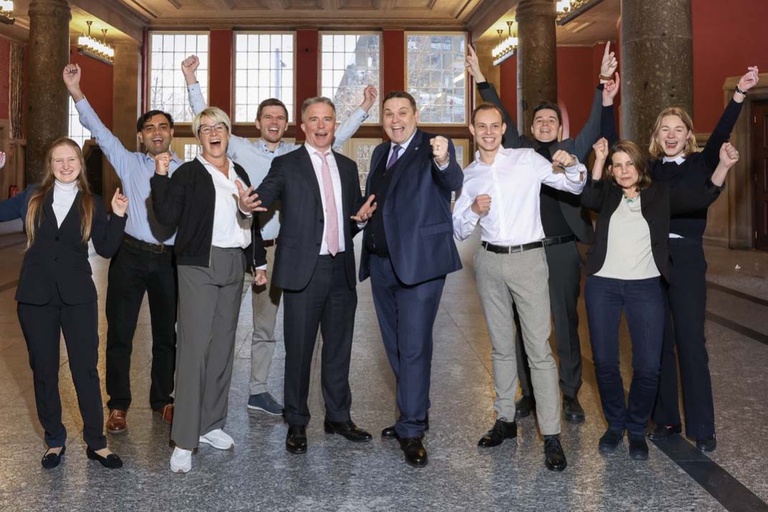
“In the field of circular economy, there is unfortunately still a wide gap between political aspirations and reality. We want to change that and thereby contribute to a more sustainable society,” says Prof. Dr Frank Balle, professor at the Institute for Sustainable Systems Engineering (INATECH) at the University of Freiburg. Together with Prof. Dr Jan Henrik Klement from the Faculty of Law, he founded the research group. The aim of the two scientists and their CircEL team is to demonstrate specifically how better recycling of engineering systems can be achieved and to enable a legal framework that takes this requirement into account.
This poses a variety of challenges, given the numerous legal requirements ranging from classic waste law to product design law and, for example, warranty law for material defects. “We need a pioneering spirit in both disciplines, a great willingness to listen to each other and a lot of enthusiasm for the cause,” says Klement.
Sustainability and transformation research
With the help of funding from the Carl Zeiss Foundation, four interdisciplinary doctoral theses and two postdoctoral positions are to be created in Freiburg, among other things. Expert workshops, specialist conferences and joint publication projects are also planned. “With our project, we also want to create a platform for future cooperation between the two faculties, from which our university will benefit in the long term,” says Balle. Klement adds: “We are building a new, permanently connected bridge between technical sustainability research and legal transformation research.”
CircEL fits perfectly into the “Paths to Sustainability” focus area of the University of Freiburg’s research profile and strengthens the “Circularity Engineering” research field at the Institute for Sustainable Systems Engineering (INATECH). At the Faculty of Law, environmental and sustainability law is to be incorporated more strongly into the focus area of German, European and international public law, among other things. The Freiburg CircEL team is advised and supported by a group of experts from industry, legal practice and academia, as well as by economic experts.
Link to original press release: https://uni-freiburg.de/en/sustainability-in-lieu-of-a-throwaway-society-a-research-project-seeks-ways-toward-a-circular-economy/
Contact:
Kerstin Steiger-Merx
Representative PR/Marketing
Faculty of Engineering
University of Freiburg
Tel.: +49 (0)761/203-8056
Email: steiger-merx@tf.uni-freiburg.de
Prof. Dr.-Ing. Frank Balle
Department of Sustainable Systems Engineering
Walter and Ingeborg Herrmann Chair for Power Ultrasonics and Engineering of Functional Materials (EFM)
Email: EFM@inatech.uni-freiburg.de