
Sustainable Soft Robotics Breakthrough at IMTEK
Researchers from the SoftLab and NeptunLab at the Department of Microsystems Engineering (IMTEK) have achieved a major milestone in sustainable soft robotics. Their joint work on developing bio-based, light-curable materials for 3D-printed soft robots has been published in the prestigious journal Advanced Science, opening new avenues for eco-friendly, high-performance robotic systems.
The study introduces, for the first time, a photocurable, bio-based resin derived from soybean oil, fully suitable for the monolithic fabrication of complex soft robots using Digital Light Processing (DLP). This work addresses one of the central challenges in soft robotics: the strong dependence on petroleum-based, non-sustainable polymers.
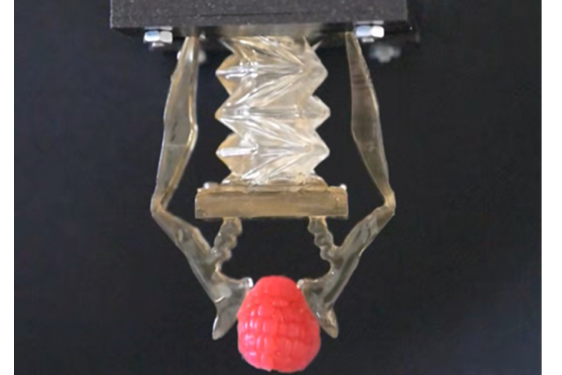
Despite its lower stretchability compared to silicone elastomers, the origami-inspired design principle—based on folding rather than stretching—enables high-performance actuators. The developed resin contains 90 wt.% renewable components and achieves a bio-carbon content (BCC) of 73%. Building on this, a monolithic soft robotic gripper was realized, successfully grasping a variety of objects and even operating reliably underwater.
The work combines the materials and process expertise of NeptunLab with the robotic system and actuator development of SoftLab, highlighting the strength of interdisciplinary research at IMTEK.
“Soft robots are polymer-based machines, and as the field grows they are expected to address sustainability concerns by moving beyond petroleum-based polymers and toward greener, bio-based chemistry. However, it is not only about polymer chemistry: polymer processing must also be considered. Soft machines require complex polymer structuring, often achievable only through 3D printing. This works, combining expertise in polymer chemistry and processing with soft robot mechanical design is a major milestone towards this goal,” states Jun.-Prof. Dr. Edoardo Milana, SoftLab.
“These works show how closely high-tech applications and materials science are interconnected, and how a breakthrough can be achieved when a problem is approached from both sides. It is becoming increasingly clear that sustainable materials are essential for these applications. It is important to rely on sustainable alternatives at an early stage so that this research can also be translated into practical applications,” adds Prof. Dr. Bastian Rapp, NeptunLab.
With this publication, IMTEK sends a strong signal for sustainable, additive manufacturing in soft robotics, demonstrating how bio-based materials can pave the way toward more environmentally friendly robotic systems.
Link to the full article in Advanced Science:
https://advanced.onlinelibrary.wiley.com/doi/10.1002/advs.202520529
Contact:
Kerstin Steiger-Merx
Representative PR/Marketing
Faculty of Engineering
University of Freiburg
Tel.: 0761/203-8056
E-Mail: steiger-merx@tf.uni-freiburg.de
Jun.-Prof. Dr. Edoardo Milana
Soft Machines – SoftLab
Department of Microsystems Engineering (IMTEK)
University of Freiburg
Email: milana@imtek.de
Prof. Dr.-Ing. Bastian E. Rapp
Process Technology – NeptunLab
Department of Microsystems Engineering (IMTEK)
University of Freiburg
E-Mail: bastian.rapp@imtek.uni-freiburg.de